The Court of Public Opinion

Where the Internet
Decides the Verdict

Real-life dilemmas, ethical conflicts, and controversial stories presented as court cases. Review the evidence, hear both sides, and cast your vote.

10
Total Cases
4
Votes Cast
1
Comments
Our Courts

Choose Your Courtroom

Latest Dilemmas

Recent Cases

Political Court

Does AIPAC Have Too Much Influence Over U.S. Politics?

Plaintiff

Critics, some lawmakers, and political activists who argue that AIPAC has outsized influence over U.S. foreign policy decisions and congressional behavior.

Defendant

AIPAC (American Israel Public Affairs Committee) and its supporters, who argue it is a lawful advocacy group exercising free speech and political participation like any other lobbying organization.

---

Few topics in American politics spark more disagreement than lobbying power in Washington.

At the center of one of the most debated issues is AIPAC, a long-standing pro-Israel advocacy group that works to influence U.S. foreign policy and strengthen U.S.–Israel relations.

To supporters, AIPAC is simply one of many interest groups operating within the American political system. They argue it represents millions of Americans who support close ties between the United States and Israel, and that it participates in the political process through legal donations, endorsements, and advocacy.

To critics, however, AIPAC represents something more powerful and more controversial: a lobbying organization with significant influence over elected officials, foreign policy decisions, and congressional voting behavior.

Critics point to the large amount of campaign donations flowing into U.S. elections from AIPAC-backed political action committees and affiliated donors. They argue that these contributions can make it difficult for lawmakers to oppose positions favored by the organization without risking political consequences.

Some also highlight the fact that bipartisan support for Israel-related policy is often extremely strong in Congress, arguing that dissenting voices sometimes face pressure, backlash, or challenges in primary elections.

Supporters strongly reject this interpretation.

They argue that AIPAC does not control policy or politicians, but instead reflects existing public and congressional support for the U.S.–Israel relationship. They also emphasize that lawmakers are free to vote against AIPAC-backed positions and that many do.

They point out that in a system built on lobbying, many industries and advocacy groups—including defense, tech, healthcare, and labor unions also spend significant resources influencing policy.

From this perspective, singling out AIPAC ignores how Washington generally operates.

The debate becomes more heated when discussions shift to foreign policy decisions, military aid, and diplomatic support for Israel.

Critics argue that lobbying pressure can contribute to policies that are not always debated openly enough in public forums.

Supporters counter that U.S. foreign policy decisions are ultimately made by elected officials based on national interest, security concerns, and longstanding alliances—not lobbying groups.

Despite the intensity of the debate, there is no consensus.

Some view AIPAC as a powerful but normal part of democratic politics.

Others view it as an unusually influential force that deserves more scrutiny than it currently receives.

What remains clear is that the argument is not just about one organization, it reflects a broader question about money, influence, and transparency in American politics.

---

Questions Before The Court

  • How much influence should lobbying groups have in a democracy?
  • Does financial political support equal control over policy?
  • Is AIPAC uniquely influential, or just one of many powerful lobbying organizations?
  • Where is the line between advocacy and undue influence?
0 votes
Political Court

Is Donald Trump Profiting From The Presidency?

Plaintiff

Ethics watchdogs, government accountability groups, and political critics who argue that President Donald Trump's business interests are creating unprecedented conflicts of interest.

Defendant

President Donald Trump, who denies wrongdoing and says his businesses are legally separate from his duties as president.

---

Donald Trump has spent much of this year facing renewed accusations of corruption and self-dealing.

This time, the controversy isn't centered on election investigations or classified documents.

Instead, it revolves around money, business, and whether a sitting president should be allowed to profit from ventures that may benefit from his political influence.

One of the biggest concerns involves the Trump family's growing involvement in cryptocurrency.

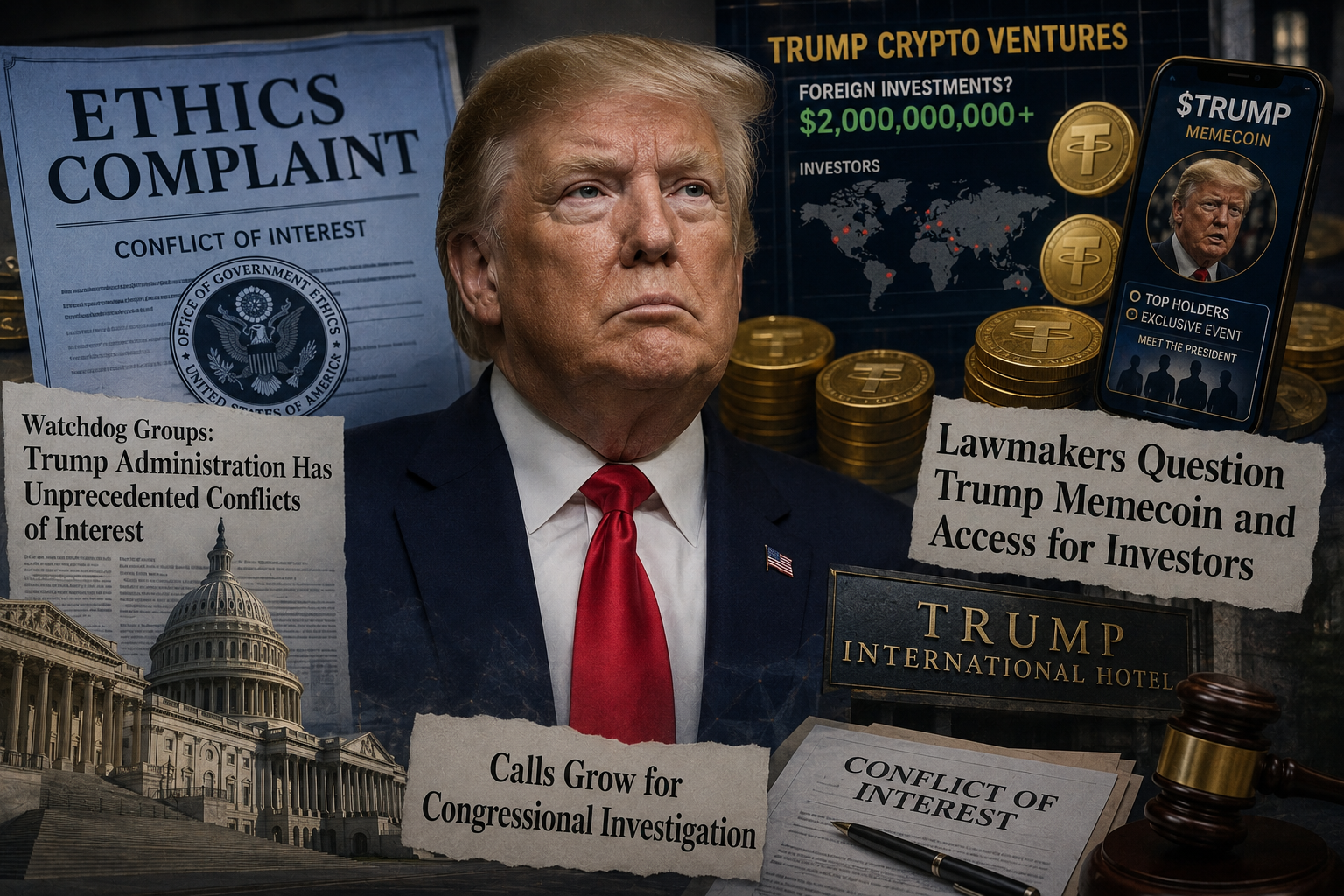
Ethics groups and some lawmakers have questioned investments tied to Trump's crypto businesses, including reports that foreign-linked investors and wealthy individuals have poured large sums of money into ventures connected to the Trump family. Critics argue that these investments create at least the appearance that wealthy individuals could gain influence by financially supporting businesses associated with the president.

Another major concern involves the Official Trump memecoin.

Several lawmakers and ethics experts have raised questions about whether events and access connected to the coin could be viewed as selling influence or special access to the president. While no court has ruled that the project is illegal, critics argue that a president's name and political influence should not be intertwined with speculative financial products.

Watchdog organizations have also accused the administration of creating opportunities for political allies and major supporters to receive favorable treatment, including appointments, policy decisions, and reduced regulatory scrutiny.

Some organizations have gone as far as calling the current administration one of the most conflict-ridden in modern American history.

Trump and his supporters strongly reject those accusations.

They argue that the president has been under constant scrutiny for nearly a decade and that many of the claims are politically motivated attacks designed to weaken him.

They also note that accusations and ethical concerns are not the same as criminal findings.

As of today, no court has convicted Donald Trump of corruption related to these recent allegations.

That has left the country deeply divided.

To critics, the appearance of conflicts is itself dangerous because it can erode public trust in government.

To supporters, the accusations are simply another chapter in the years-long effort to target Trump politically.

The question now is whether these business ventures represent legitimate ethical concerns—or whether the term "corruption" is being used too broadly in America's increasingly polarized political climate.

---

Questions Before The Court

  • Is the appearance of a conflict of interest enough to undermine public trust?
  • Should sitting presidents be completely separated from their business interests?
  • Do these allegations warrant further investigations?
  • Is this evidence of corruption, or simply an example of modern politics becoming increasingly intertwined with business?
0 votes
Political Court

Donald Trump and Corruption

Plaintiff

Critics, ethics watchdogs, and political opponents who argue that Donald Trump repeatedly blurred the lines between his private business interests and public office.

Defendant

Former U.S. President Donald Trump, who has consistently denied wrongdoing and argues that many of the accusations against him are politically motivated.

---

Few politicians in modern history have faced as many allegations of corruption as Donald Trump.

To his supporters, he is an outsider who challenged the political establishment and became the target of endless investigations because he refused to play by Washington's rules.

To his critics, he represents one of the clearest examples of how political power can be used for personal and financial gain.

The debate began even before Trump entered the White House.

As a billionaire businessman, he owned hotels, golf courses, licensing deals, and other businesses around the world. When he became president in 2017, many ethics experts raised concerns about whether his business interests could create conflicts with his duties as president.

Unlike previous presidents, Trump did not fully divest from his businesses. Instead, control of his company was handed to his sons while he remained the owner.

Critics argued that this arrangement created opportunities for foreign governments, lobbyists, and special interests to spend money at Trump-owned properties in an attempt to gain influence.

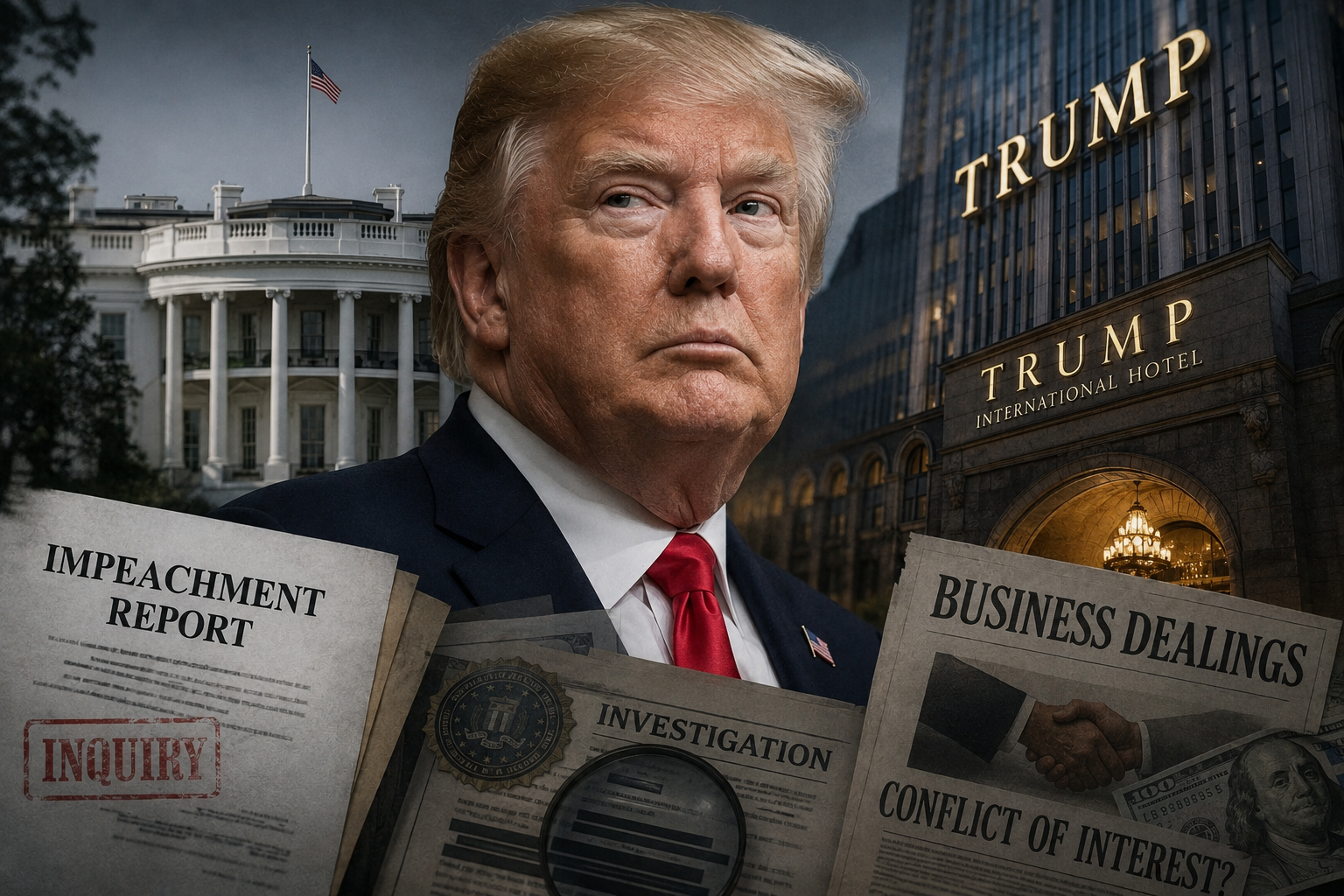
One of the biggest controversies involved the Trump International Hotel in Washington, D.C., which became a popular destination for foreign officials and political groups during his presidency.

Opponents claimed that money flowing into Trump-owned businesses while he was president created at least the appearance of a conflict of interest.

Trump denied these accusations and said his businesses lost money because of his decision to serve in office.

Questions about corruption followed him throughout his presidency.

Critics accused him of using government resources to benefit allies, rewarding loyal supporters with political appointments, and firing officials who were investigating people close to him.

His first impeachment centered on allegations that he pressured Ukraine to investigate a political rival while military aid to the country was temporarily withheld.

Trump denied any wrongdoing and called the impeachment a political attack.

After leaving office, the controversies continued.

Multiple investigations examined his handling of classified documents, efforts to challenge the 2020 election results, and business practices within the Trump Organization.

In separate civil cases, courts found that the Trump Organization had committed financial fraud by inflating the value of assets for business purposes, though Trump has continued to deny wrongdoing and has appealed many of the rulings.

More recently, critics have also questioned whether Trump's growing business ventures—including media companies and cryptocurrency projects connected to his brand—could create new conflicts of interest if he returns to office.

Supporters reject nearly all of these allegations.

They argue that Trump has been investigated more than almost any politician in American history and yet has not been convicted of corruption while serving as president.

They believe many of the accusations are driven by political opponents and media organizations that have opposed him from the beginning.

For others, however, the sheer number of investigations, lawsuits, and ethical questions surrounding Trump raise concerns about whether business interests and political power have become too closely intertwined.

The debate remains one of the most divisive issues in American politics.

Is Donald Trump the victim of unprecedented political attacks?

Or do the many allegations point to deeper concerns about corruption and accountability in government?

---

Questions Before The Court

  • Should presidents be required to completely separate themselves from their businesses while in office?
  • Is the appearance of a conflict of interest enough to damage public trust?
  • Have the investigations into Trump revealed genuine ethical concerns, or are they primarily political battles?
  • Can a wealthy business owner effectively avoid conflicts of interest while serving as president?
1 votes
Relationship Court

My Mom Abandoned Me When I Was 5

Plaintiff

A man who was abandoned by both of his parents as a young child and later tracked down his mother after more than 40 years.

Defendant

His biological mother, who disappeared without warning, never contacted her children again, and showed little interest in reconnecting after being found decades later.

---

Some childhood memories never fade.

For the plaintiff, one moment has stayed with him for nearly his entire life.

He was just five years old when he came home from kindergarten and discovered that his mother was gone.

She hadn't gone to work.

She hadn't gone to the store.

She had simply moved away.

Without saying goodbye.

Without leaving an explanation.

Without taking her children.

As he walked through the house, he found his three-year-old brother sitting alone in a small rocking chair, clutching his teddy bear and crying.

Over and over again, the little boy repeated the same heartbreaking words:

"Mommy doesn't love me anymore."

The plaintiff says it's a memory he has never been able to forget.

A few days later, their father drove the four brothers to an aunt's house.

He told them he would be back in a couple of days.

He never came back.

The next time the plaintiff saw his father was nearly a decade later.

He was 14 years old and barely recognized him.

According to the plaintiff, his father had become a severe alcoholic, was often homeless, and drifted in and out of his life only a handful of times before eventually passing away.

Years later, another family secret came to light.

When the plaintiff was 15, he learned that he had an older brother he had never known existed.

His mother had abandoned that child as well.

For decades, no one knew where she had gone.

Not even her own brothers and sisters.

The plaintiff says his grandmother died without ever learning what had happened to her daughter.

Then, more than 40 years after she disappeared, one of the plaintiff's aunts hired a private investigator.

The investigator found her.

The plaintiff and one of his brothers agreed to meet their mother, hoping to finally get answers after a lifetime of questions.

Instead, they left disappointed.

According to the plaintiff, their mother showed little emotion during the meeting.

She didn't seem interested in rebuilding a relationship.

She showed no real concern that one of her sons had already passed away before she was found.

The plaintiff says she appeared completely detached from the pain her disappearance had caused.

That meeting would also be their last.

He has never seen or spoken to her again.

Now approaching 90 years old, she remains alive, although the plaintiff says only one aunt still checks in on her every few months to see how she's doing.

The plaintiff has no plans to reconnect.

In hopes of uncovering more of his family's history, he later submitted his DNA to a genealogy service to see if there were any other siblings he didn't know about.

So far, none have appeared.

Although he finally found the answers he had spent decades searching for, they weren't the answers he had hoped to hear.

---

Questions Before The Court

  • Is there any circumstance that could justify abandoning young children without explanation?
  • Should the plaintiff have given his mother another chance after finally finding her?
  • Does being someone's biological parent automatically deserve forgiveness?
  • Can some family relationships be too broken to repair?
0 votes
Relationship Court

My Girlfriend Called My Late Brother's Memorial A "Stupid Tradition"

Plaintiff

A 30-year-old man who refused to skip his yearly tradition of honoring his late brother, despite pressure from his girlfriend.

Defendant

His girlfriend of nine months, who believed he should have postponed the tradition to join her and her mother for lunch.

---

A couple's relationship has come to an abrupt end after a disagreement over how one man chooses to honor his late brother.

The plaintiff says he lost his younger brother to cancer eight years ago.

His brother was only a young man when he passed away after a long fight with the disease.

Since then, the plaintiff has followed the same personal tradition every year on the anniversary of his brother's death.

He takes the day off work, visits his brother's grave, donates blood in his memory, returns home, and watches his brother's favorite movie.

He says the routine brings him peace and helps him feel connected to someone he still misses deeply.

This year, however, the tradition became the center of an argument with his girlfriend.

The defendant, who had been dating the plaintiff for about nine months, asked him to join her and her mother for lunch while her mother was visiting town.

The plaintiff declined.

He explained that it was the anniversary of his brother's death and that he planned to spend the day following the tradition he had observed every year since losing him.

According to the plaintiff, the defendant didn't understand.

Instead, she told him that having lunch with her mother whenever she visited was also a tradition.

She then suggested he could simply donate blood on another day.

The plaintiff tried to explain that the day wasn't just about donating blood.

It was about remembering his brother in a way that had become deeply meaningful to him.

Later that evening, while he was at home watching his brother's favorite movie, the defendant messaged him again and asked if he would reconsider joining them.

Once again, he politely declined and said he would happily spend time with her mother the next time she visited.

According to the plaintiff, the conversation quickly turned hurtful.

He says the defendant accused him of embarrassing her in front of her mother.

She allegedly called him selfish and lazy and dismissed his annual memorial as a "stupid tradition."

The argument left the plaintiff questioning the future of the relationship.

A few days later, he reached out and told her they needed to talk.

She never replied.

Instead, she blocked him on social media, WhatsApp, and every other platform they used to communicate.

Even her best friend reportedly blocked him.

Although surprised by how things ended, the plaintiff says he isn't heartbroken.

In fact, he believes the breakup confirmed that they weren't compatible.

Looking back, he feels his tradition may have saved him from committing to a relationship with someone who didn't respect something so important to him.

Now he's wondering whether refusing to change his plans made him unreasonable or whether his girlfriend crossed a line by expecting him to.

---

Questions Before The Court

  • Was the plaintiff right to refuse lunch with his girlfriend and her mother?
  • Should deeply personal memorial traditions ever be postponed for a partner?
  • Did the defendant disrespect the plaintiff's grief by calling his tradition "stupid"?
  • Was ending the relationship the best outcome for both of them?
0 votes
General Court

I Slapped A Teenager That Untied My Bikini At A Water Park

Plaintiff

A 32-year-old woman who slapped a teenage boy after he allegedly untied the strings of her bikini top without her consent.

Defendant

A teenage boy, believed to be between 15 and 17 years old, who allegedly pulled the woman's swimsuit strings as a prank.

---

A family trip to a water park ended in a heated confrontation after what started as an alleged prank quickly turned into accusations of assault.

The plaintiff says she was spending the day at the water park with her husband and young daughter.

The family was in one of the pools, quietly practicing swimming lessons, when a group of teenage boys entered the area.

According to the plaintiff, she wasn't interacting with them and was focused entirely on helping her daughter.

Then, without warning, she felt someone tugging on the strings that tied the back of her bikini top.

She immediately spun around.

Standing behind her was a teenage boy, who she estimates was between 15 and 17 years old.

She says he had a smirk on his face.

Reacting in the moment, the plaintiff slapped him across the face.

The slap immediately caused a scene.

Water park staff rushed over as the boy's parents confronted the plaintiff, furious that she had struck their son.

The situation quickly became a standoff.

Fortunately, the plaintiff says her husband witnessed the incident and confirmed that the teenager had grabbed her swimsuit.

Another woman nearby also reportedly saw what happened and backed up her version of events.

The park's security cameras captured part of the incident, although the plaintiff says the angle wasn't clear enough to show everything.

According to the plaintiff, the boy's parents threatened to press assault charges against her for slapping their son.

She responded by saying she would pursue sexual assault charges if they chose to take legal action.

Eventually, water park staff asked both parties to leave the park.

Since then, neither side has taken further legal action.

However, the incident continues to divide opinion.

Even the plaintiff's husband believes she may have overreacted by slapping the teenager.

The plaintiff disagrees.

She believes someone who intentionally tries to remove another person's clothing without consent should expect an immediate response.

Now she's wondering whether defending herself in the moment made her the one in the wrong.

---

Questions Before The Court

  • Was the plaintiff justified in slapping the teenager?
  • Did the teenager's actions amount to a serious violation of personal boundaries?
  • Should the plaintiff have reported the incident instead of reacting physically?
  • Was this self-defense, or did the plaintiff overreact?
0 votes